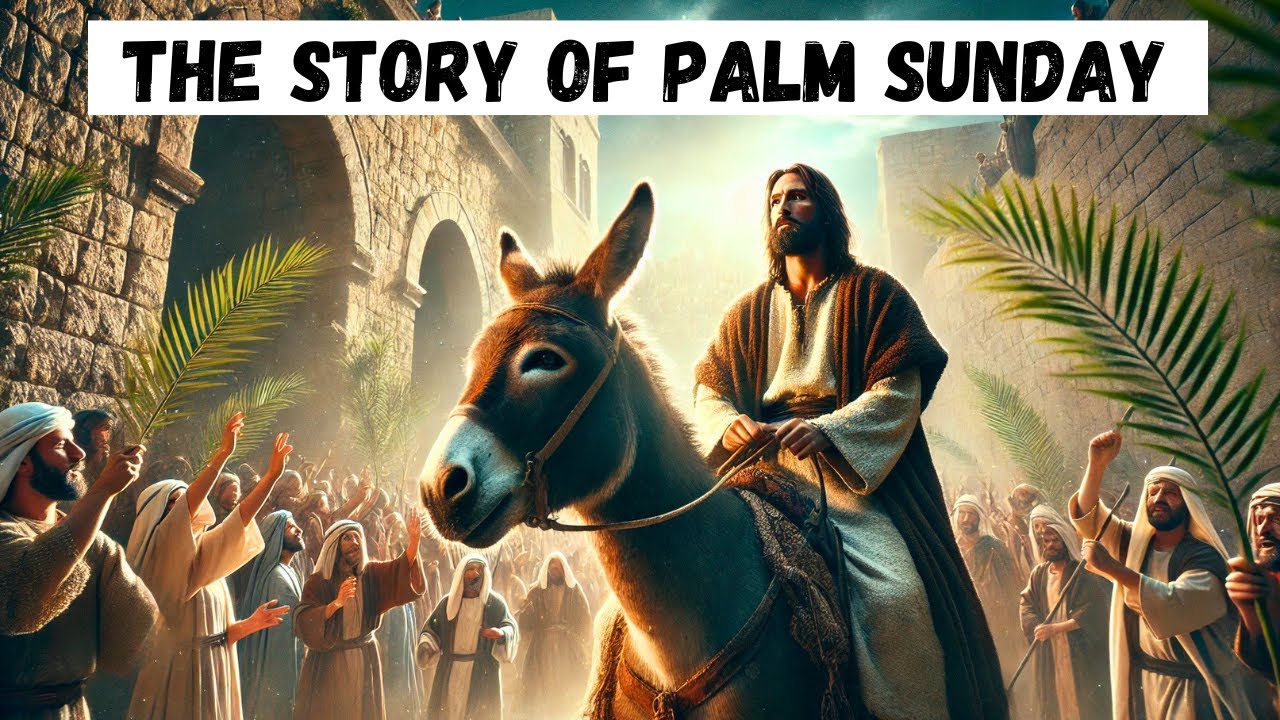
At the beginning of that week that would change history, a powerful scene unfolded in the streets of Jerusalem. Jesus riding on a young donkey was welcomed with celebration, singing and palm branches by a joyful crowd shouting, “Hosana to the son of David.” It was a moment of public exaltation, an expression of recognition that felt like a spiritual coronation. The city was stirred and the echoes of the crowd’s praise seemed to pass through the city gates as if the promised kingdom was finally about to appear. Hopes of freedom from Roman rule filled the hearts of the people.
There was excitement in the air, but also deep misunderstanding. They proclaimed him as king, but they didn’t grasp what kind of kingdom he had come to establish. 5 days later, that same crowd, or at least a large part of it, was no longer holding palm branches, but stones in their hearts. They were no longer shouting, “Hosana,” but instead, “Crucify him!” with the same intensity they had once used to praise him.
The contrast was almost unbelievable. The man they had celebrated as the promised Messiah was now being handed over as a criminal. The speed of this change wasn’t just shocking, it was revealing. It exposed the instability of the human soul. The way hearts can be guided more by desires than by true conviction.
Jesus had not changed. He remained the same. But the crowd revealed that worship without understanding is fragile, and faith without deep roots can be quickly swept away by the winds of disappointment. This dramatic shift did not come from anything lacking in Jesus’ character, but from the misplaced expectations of the people. For generations, the Jewish people had been waiting for a warrior Messiah, a leader with a sword in hand, who would free Israel from its enemies and restore the throne of David with glory and power.
That was the image beating in the hearts of the crowds. When they saw Jesus perform miracles, raise the dead, and teach with authority. They projected their political and social hopes onto him. They expected the Messiah to rise up with earthly power, take control of the temple and overthrow the government. But everything Jesus did challenge those expectations.
He spoke of serving, not ruling, of forgiving, not avenging, of laying down his life, not taking others. At first, the disappointment was quiet. The days that followed Jesus’s triumphal entry were filled with words of warning, acts of cleansing, and direct confrontations with religious leaders. Instead of gathering an army, Jesus drove out the money changers from the temple. Instead of calling for rebellion, he taught that we should love our enemies and forgive 70* 7.
Slowly, the crowd began to realize that this Messiah would not march against Rome, would not break political chains, would not lead a popular uprising. Their hope for immediate liberation was replaced with restless confusion. And where confusion grows, manipulation finds fertile ground. The religious leaders who had already decided to kill Jesus saw in the crowd’s disappointment a strategic opportunity. They stirred the people with insinuations, twisted his teachings, and planted seeds of doubt in vulnerable hearts.
All it took were a few rumors, hints of heresy, whispers of political danger, and the excitement turned into suspicion. The same crowd that once shouted, “Hosana!” was led step by step toward crucify him. They weren’t forced by a violence but swayed by their own frustrations. The applause stopped because this Messiah didn’t serve their agenda.
And when God doesn’t fit into the mold we’ve created, humanity is often quick to reject him. The idolatry of the people wasn’t in the image of a golden calf, but in the image of a Messiah shaped by personal expectations. Jesus wasn’t the Messiah they had imagined. And because of that, they failed to recognize him. They expected a conqueror riding a horse, but they received a servant riding a donkey.
They longed for a liberator who would break external chains, but he came to break the chains within. The rejection wasn’t of Jesus as a person, but of the kind of kingdom he came to represent. The human heart is quick to embrace a God who affirms its desires, but resists a God who challenges its intentions. That’s why the crowd’s faith was unstable. It wasn’t grounded in revealed truth, but in assumptions fueled by centuries of distorted interpretations.
Jesus, on the other hand, was not swayed by applause or by rejection. From the beginning, he knew how fickle the human heart can be and that the glory of that moment would be short-lived. When he heard the shouts of hosana, he wasn’t deceived. And when he heard crucify him, he wasn’t shaken. His focus was never on public approval, but on the will of the father.
Every step he took was intentional, fully aware that the same people praising him today would soon walk away. Still, he did not turn back. His love wasn’t built on recognition, but on mission. And it was with that love that he continued down the path that would lead him to the cross. Before we move on, don’t forget to like this video, subscribe to the channel, and tell us in the comments where you’re watching from.
that really helps us bring more content like this and spread these powerful truths. Jesus journey to Jerusalem was not a coincidence nor a clever strategic decision. Every step was the fulfillment of ancient prophecy carefully preserved in the scriptures and long awaited by generations. As he approached the city from the small village of Bethany, he carried with him not only the memory of Lazarus’s resurrection, but also the symbolic weight of centuries of messianic hope. The prophecy of Zechariah, which spoke of a king coming, humbly riding on a donkey was beginning to unfold before the people’s eyes.
And this was no staged performance. Jesus deliberately chose to live out and fulfill every detail written about him as if sealing a divine covenant with time and eternity. When he sent two of his disciples to retrieve the animal, the master revealed his complete authority over the events. “Go into the village ahead of you, and at once you will find a donkey tied there with her colt by her,” he said. Even without being physically present, he knew exactly what they would find.
This wasn’t a random act. It marked the visible beginning of a silent proclamation. The king of Israel was entering his city not with the grandeur of earthly kings, but with the humility of a servant. The scene unfolded with a natural somnity. The disciples obeyed and found things just as Jesus had said.
They brought the animal and made a makeshift saddle out of their cloaks, unaware they were taking part in the most sacred moment of their generation. As the young donkey walked slowly forward, the crowd, inspired by the gesture and by the memory of the prophet’s words, began spreading their own cloaks along the road. Others cut branches from palm trees and waved them like banners. of victory. The echoes of Psalm 118 filled the air.
Hosana to the son of David. Blessed is he who comes in the name of the Lord. It was more than spontaneous praise. It was a spiritual response to something beyond human understanding. The people saw Jesus as the heir to David’s throne, the long- awaited deliverer.
But what they didn’t yet understand was that his kingdom would not be sealed with swords, but with nails and blood. Jerusalem was packed because of the Passover. Pilgrims from all directions filled the dusty roads, bringing with them a sense of anticipation. The city was preparing to remember the deliverance from Egypt, but the true Passover lamb was still unknown to many. Jesus entrance along the slopes of the Mount of Olives was more than just a geographical movement.
It was deeply spiritual. Invisible angels accompanied the procession. Heaven watched in silence and time itself seemed to bend before eternity. Those narrow streets paved with ancient stones were now receiving the creator of the universe humbly riding a simple creature choosing to conquer not by force but by meekness. The religious authorities, unsettled by the singing and the swelling, crowds tried to interrupt the moment.
Teacher, rebuke your disciples, said the Pharisees. But Jesus answered with firmness and conviction. If they keep quiet, the stones will cry out. That wasn’t just poetic imagery. It was a powerful declaration that the entire universe recognized what hardened hearts could not.
The earth, the heavens, and all creation knew that this was the promised king. Only those blinded by religion and hardened by tradition refused to see the literal fulfillment of God’s word. Among the crowd were Martha, Mary, and Lazarus. They said little, but their eyes were filled with meaning. Lazarus, living proof of power over death, stood as a symbol that the one entering Jerusalem was not just a teacher or prophet, but the Lord of life.
Mary, who had once anointed the master’s feet with costly perfume, looked on with reverence and sorrow, as if she sensed the time of his departure was near. Martha, ever practical and faithful, was preparing both her home and her heart for what was to come. The atmosphere was sacred. With every step the donkey took, the prophecy grew clearer, and the shadow of the cross began to fall over the city. The crowd’s excitement that Sunday masked an unspoken tension.
The Jewish people, weary from Roman rule, had long held on to a centuries old hope, the coming of a warrior Messiah, someone who would restore the glory of Israel and free the nation from foreign oppression. To them, Jesus of Nazareth seemed to fit the role. He had charisma, wisdom, performed miracles, and spoke with authority. He was the kind of leader who could stir hearts and spark a successful rebellion. So when they saw him riding a donkey heading toward the religious and political center of the nation, their cries of hosana were mixed with political expectations they didn’t fully understand.
The problem wasn’t the praise. It was the motivation behind it. Those men and women didn’t grasp the true meaning of the kingdom Jesus had come to reveal. They expected a king with a sword on his side, armies behind him, and declarations of power. They longed for immediate restoration of their national status, justice served, and enemies humbled.
But the kingdom Jesus brought was of a different nature. It was invisible to the eye, yet real in the spirit. A kingdom not built with stones, but with repentance. a reign that began in the heart and showed itself through love, forgiveness, truth, and righteousness. This deep contrast between the people’s expectations and Christ’s divine mission led to growing frustration.
Day by day after Jesus entered Jerusalem, their uneasiness grew because he wasn’t doing anything against Rome. He didn’t summon troops. He didn’t storm military outposts. He didn’t burn imperial banners. Instead, he kept speaking in parables and teaching about gentleness, humility, and serving others.
The same crowd that once dreamed of a revolution began to wonder, did we get it wrong? And in that wide gap between human expectations and God’s eternal plan, the poison of disappointment began to spread. Even among the disciples, this confusion was evident. Peter, for example, once rebuked Jesus when he spoke of his impending death. He couldn’t accept a suffering Messiah.
He wanted a victorious, unbeatable leader. James and John argued over who would sit at Jesus’ right and left in his earthly kingdom. None of them imagined that instead of thrones, there would be crosses. The cross had no place in the nationalistic theology the people had built over the centuries. So when Jesus refused to follow the expected script, many who had once followed him with palm branches and cloaks began to quietly walk away.
The religious leaders, ever watchful of the growing frustration, seized the opportunity. They began planting seeds of doubt among the people, suggesting that Jesus was a false prophet, a blasphemer who was putting the nation’s safety at risk. According to the popular belief, the true Messiah was expected to bring visible victories since Jesus preached submission, forgiveness, and surrender. It only took a bit of emphasis on that contradiction to undermine the crowd’s trust. And that’s exactly what they did.
While the people waited for signs of rebellion, the priests and Pharisees whispered, “He’s not who you think.” If he were the chosen one, he would have acted by now. The gap between genuine faith and political expectation reached its peak when the people realizing that Jesus would not fulfill their human hopes turned their backs on him. The same mouths that once cried out, “Blessed is he who comes in the name of the Lord,” now shouted, “Crucify him!” It wasn’t just a mistake in judgment.
It was a conscious rejection of a kingdom that didn’t match their expectations. When they saw that he wouldn’t destroy their oppressors, they chose to side with them instead. Christ’s truth revealed a hidden idolatry in many hearts, the desire for earthly glory over divine will. Yet Jesus did not alter his mission because of people’s misunderstanding. He remained steady, faithful to the eternal purpose.
His entrance into Jerusalem was a proclamation. The kingdom was already among them, but it would be revealed in an unexpected way. Just days before entering Jerusalem, Jesus had performed one of the most powerful signs of his ministry, the resurrection of Lazarus. Bethany, a small village just a few miles from the capital, became the backdrop where death had to bow before the word of the son of God. Lazarus had already been in the tomb for 4 days.
The stench of decay was a final verdict to human eyes. But Jesus with a firm voice and heavenly authority cried out, “Lazarus, come out.” And the dead man came out. There were no magic formulas, just a divine demonstration of power over life and death. The news spread quickly, stirring both, or in fear.
For many, this miracle was the ultimate confirmation that Jesus was the Messiah. After all, who else could raise the dead with just a word? People began to gather in great numbers, not only to see Jesus, but to witness Lazarus, the man who had returned from the grave. Bethany became a center of spiritual commotion. The resurrection shook hearts and lifted hopes, but it also sent tremors through the corridors of religious power.
The miracle didn’t just confirm Jesus’ authority. It directly challenged that of the temple leaders who could no longer hide their unease. The Sanhedrin made up of Pharisees, Sadducees, and elders saw Lazarus’s resurrection as an imminent threat. Their fear was not only theological but deeply political. If people started following Jesus as the Messiah, the fragile balance with Rome would collapse.
They worried that a popular uprising would provoke the empire into harsh retaliation, destroying the temple and stripping them of their power. It was in this context that Caiaphas, the high priest that year, unknowingly spoke a prophetic truth. It is better that one man die for the people than that the whole nation perish. His words carried a divine weight. Even though his intention was simply to eliminate what he saw as a threat.
From that moment on, the plan to kill Jesus was no longer just an idea. It became a strategic decision. The miracle of Lazarus was the breaking point for the religious leaders. It was no longer a matter of debate, but of institutional survival. They couldn’t allow a man with such spiritual power and popular influence to keep stirring the crowds.
And Lazarus in turn became an inconvenient symbol. His very existence was living proof of the impossible. That’s why they also plotted to kill Lazarus in a desperate attempt to erase the evidence of God’s glory. But what the temple leaders failed to understand was that they were fighting against something that couldn’t be stopped. Jesus didn’t operate under human systems of power.
He wasn’t dependent on religious structures or political influence. His kingdom was a quiet advance, a spiritual revolution that grew in every heart touched by the truth. The miracle in Bethany wasn’t just a spectacular event. It was a turning point. While some saw Jesus as a threat to the system, others began to glimpse true freedom.
Not from Rome’s grip, but from the power of death itself. The tension increased with each passing day. Lazarus remained silent, but his silence spoke volumes. He didn’t need to preach. His presence spoke for him.
The people looked at him as if staring at the unexplainable. He was a constant reminder that the Messiah was among them doing what no one else had ever done. And that was intolerable to the guardians of a system that had grown comfortable in hypocrisy and religious profit. The miracle didn’t just bring faith. It brought crisis.
And for those afraid of losing control, every crisis is a threat to be eliminated. Even knowing that his actions had triggered the fury of the leaders, Jesus did not back down. On the contrary, he moved toward Jerusalem with unwavering purpose. He didn’t run from conflict. He knew that every act was part of an eternal plan.
The resurrection of Lazarus was more than a display of power. It was a declaration. The power of life was among them, and nothing would ever be the same. But at the same time, those clinging to the system chose to plan the death of the one who gave life. While the people celebrated, the corridors of the temple filled with conspiracy from the Mount of Olives.
As he descended toward the city, Jesus looked upon Jerusalem, not with pride or excitement, but with tears in his eyes. He wept for the city that failed to recognize the time of its visitation. The Messiah entered not in triumphant joy, but in sorrow. He knew that the same city welcoming him with celebration would soon hand him over to humiliation. The contrast between the warm reception and the looming rejection was a burden he carried in silence, his gaze fixed on the eternal purpose.
The triumphal entry was in fact a silent indictment of the kind of messiah the people wanted. They longed for a warrior, king, but received a servant. They expected someone to establish a visible dominion, but saw a peaceful man riding on a donkey. It was the beginning of a collision between the kingdom of God and human expectations. Jesus didn’t come to fulfill the crowd’s desires.
He came to fulfill a divine plan written before the foundation of the world. Every step he took was a declaration of identity and mission. As the people spread their cloaks on the ground and waved palm branches, they were celebrating a victory they didn’t yet understand. The scene looked like triumph, but it was truly a march towards sacrifice. Jesus entry into Jerusalem was a proclamation of the kingdom, but not as people imagined.
It was the foretaste of the scandal of the cross, of humiliation and surrender. And yet, even in the face of collective misunderstanding, the king entered not to conquer by force, but to redeem through surrender. Glory would not come through the praise of the crowds, but through obedience to the father until the very end. Right after the triumphal entry, Jesus went to the spiritual heart of the Jewish faith, the temple in Jerusalem. What was meant to be a sacred place of encounter with God had been taken over by money changers, merchants, and priests who had turned the house of prayer into a noisy marketplace.
The holy courtyards were filled with animals for sale, inflated prices, and exploitative transactions. It was as if the temple had been defiled from within, not by foreigners, but by the very religious leaders who were supposed to protect its holiness. As Jesus walked through those columns, he didn’t just see commerce. He saw corrupted worship, the replacement of genuine faith with a system driven by interest, profit, and appearances. The heart of religion had been compromised.
So without hesitation, the master made a whip out of cords and drove out the merchants. He overturned the tables, scattered the coins, and knocked over the benches of the sellers. That gesture, though seemingly violent, was an act of holy justice. He wasn’t acting out of uncontrolled anger, but with the righteous indignation of someone who knew the true purpose of the temple. The words that echoed through the marble and columns were as sharp as blades.
It is written, “My house will be called a house of prayer, but you are making it a den of thieves.” This wasn’t just a rebuke. It was a direct accusation against the religious system. Jesus wasn’t just calling out the merchants. He was exposing the entire scheme that had turned faith into a transaction.
The leaders knew he was speaking against them, challenging the structure of power and the facade of piety they had built over decades. While the priests and elders plotted in silence, something extraordinary happened in the midst of the chaos. The blind, the lame, and the sick came to Jesus right there in the temple, and he healed them. The marginalized found shelter. The forgotten were heard.
The poor felt welcome. It was as if the temple was finally fulfilling its true purpose, a space for divine encounter, where mercy spoke louder than ritual, and compassion triumphed over appearances. That moment, more than any previous miracle, redefined the meaning of the sacred. When the Pharisees and Sadducees saw the children singing hosana to the son of David, inside the temple, they became even more furious. To them, this was the height of blasphemy, a simple man being praised as the Messiah within the sacred precincts.
They confronted Jesus demanding an explanation, but he replied with the calm of someone who knows the truth. From the lips of children and infants, you have ordained praise. His words were a direct quote from scripture, a reminder that God chooses the humble to reveal his glory. The reaction of the religious leaders was not repentance but outrage. They realized their control was slipping away.
Jesus had not only touched the physical temple but the very foundation of the system they upheld. A power based on fear manipulated tradition and religious oppression. From that moment on, the plan to kill him was no longer just an idea. It became an official decision. There was no turning back.
The cleansing of the temple was the spark that ignited the final confrontation between the son of man and Israel’s spiritual elite. But while the elite hardened their hearts, the common people saw something different. Jesus didn’t need thrones or titles to show his authority. There, among scattered coins and fleeing animals, true worship was being reborn. It was a temple in transition.
The physical building, though magnificent, was already marked to fall. A new temple was being introduced, not made by human hands, but built on justice, truth, and love. The house of God was being restored, not with stones, but with people willing to become a living dwelling place for the spirit. The streets of Jerusalem still echoed with cries of hosana. But the fervor was beginning to fade under the weight of unmet expectations.
The people who had hoped for a political leader now watched a man speaking of the cross, of forgiveness and surrender. In the temple corridors, where the religious leaders plotted in secret, decisions were already being sealed. Jesus walked among the pillars with serenity, teaching with authority and challenging the system with truths that cut like a sword. His parables once received with curiosity now provoked division. The tension hung in the air like a thick cloud, and even the hearts that once cheered him were beginning to grow silent.
Among the leaders, patience had run out. Jesus’ words were seen as an open affront when he exposed the hypocrisy of the scribes and Pharisees in a fiery speech, calling them whitewashed tombs, blind guides of the blind, their faces tightened with restrained fury. There, among marble columns and astonished eyes, the Messiah pronounced laments over Jerusalem, the city that killed its prophets. And while the disciples still struggled to grasp the depth of his words, the silence of the city masked the roar of betrayal drawing near. Time was running out, and the lamb was already walking toward the sacrifice step by step without hesitation.
On that sacred night, while homes filled with the aromas of Passover, Jesus was preparing something the disciples could never have anticipated. Peter and John followed his instructions and found the upper room, a large furnished space where everything was ready. There, with the twel gathered around the table, Jesus stood, took a towel, and in a gesture that would echo through the centuries, washed the feet of each one. He even washed the feet of the betrayer without hesitation. It was a living lesson.
In the kingdom, authority is born from humility. He didn’t just teach with words, but with actions that disarm pride and reveal the heart of God. Around the table, the atmosphere was thick with mystery and somnity. Jesus took the bread, broke it, and said, “This is my body given for you.” Then he took the cup and declared, “This cup is the new covenant in my blood poured out for you.
” The disciples listened, stunned. They didn’t yet understand that what they were experiencing wasn’t just a meal, but the foundation of a new covenant, not written on stone tablets, but sealed in the body of the son. The supper became the eternal memorial of a kingdom built on surrender where power is revealed in the breaking of bread. Even in the face of impending pain, Jesus spoke of love. He knew that among them was a heart already given over to darkness.
Yet he didn’t cast Judas out. On the contrary, he offered him the dipped bread, the most intimate gesture of fellowship in that culture. And still the betrayer rose and left, sealing in the shadows the fate that was to unfold. Outside the city slept in ignorance, while inside that upper room, heaven and earth touched. A hymn was sung.
It was the final song before the agony. Praise preceded the cross, and the hands that broke the bread would soon be pierced by nails. The night remained still as the master left the upper room and walked with his disciples to the Mount of Olives. There, among ancient olive trees, he spoke of the trials to come, of hearts that would be sifted like wheat, of his followers who would scatter. Peter burning with zeal promised to remain faithful even to death.
But Jesus with loving warning told him before the rooster crows, “You will deny me three times.” It was the foreshadowing of human frailty before the weight of the cross. The son of God, aware of all that lay ahead, did not retreat. He walked resolutely, feet grounded in obedience and a heart broken by a love that knew it would be rejected. There the beginning of the end was unfolding or rather the end that would give rise to everything.
Jesus had exposed the hypocrites, cleansed the temple, confronted the powerful, served his own, instituted a new covenant, and prophesied the betrayal. Everything was ready. Heaven watched in silence. The angels were at their posts, and the universe held its breath. Every gesture of Christ was a preparation for the climax of history.
The disciples, still without full understanding, walked with him. The city that had once received him with cloaks was now preparing to clothe him in wounds. But the king did not waver. For the kingdom he came to establish was not of this world, and nothing, not even the cross, could stop it from being fulfilled. The day dawned under the weight of silence.
After the supper, the path led Jesus to the garden of Gethsemane, where ancient trees would witness the most intimate sorrow of the Son of God. There, withdrawing from the disciples, the master knelt and prayed in anguish while drops of sweat mixed with blood fell from his face. The heavens seemed shut and solitude pressed in. He knew what was to come, yet still he submitted, “Father, if you are willing, take this cup from me.” Yet not my will, but yours be done.
It was the weight of all humanity upon his shoulders. While the disciples slept, the Savior fought, his greatest spiritual battle, and when the agony ended, he rose, ready to face what was written. The darkness of night was pierced by the light of torches. Judas, followed by armed soldiers, entered the garden with determined steps. The kiss that sealed the betrayal also opened the way to the passion.
Jesus, calm and fully aware, did not resist. Peter, in a burst of zeal, drew his sword and wounded a servant, but the master commanded him to sheath it. His enemies did not seize him by force. It was he who surrendered willingly. Meanwhile, the disciples fled, gripped by fear.
Now the solitude was complete. Bound, Jesus was led to the religious leaders where the verdict had been decided long. Before any formal accusation, the night dragged on through lies and injustice. In the high priest’s courtyard, false witnesses twisted his words. Jesus endured the far in silence.
When he finally spoke, declaring himself to be the son of God, they tore their garments and cried out blasphemy. Meanwhile, outside, Peter warmed himself by the fire. Three times he was questioned, and three times he denied knowing the master. When the rooster crowed, his eyes met Jesus, and he went out and wept bitterly. The purity of the lamb stood in stark contrast to the frailty of men.
And while the city slept, the plan of redemption accelerated through the hands of the [Music] unjust. At daybreak, Jesus was taken to Pilate. The religious leaders wanted him dead, but lacked the authority to execute. Palot, intrigued, questioned the Nazarene, and found no fault in him. He tried to release him offered to free him according to the Passover tradition.
But the people chose Barabus, a criminal. The same voices that once cried, “Hosana!” now echoed, “Crucify him!” Pilate, fearing political unrest, washed his hands before the crowd. The decision was sealed.
Jesus would be crucified. Handed over to the soldiers mockery, he was stripped, scourged, and crowned with thorns. Every wound, every blow, every humiliation was part of the price paid in love. The journey to Golgatha was slow and heavy. The cross pressed down on shoulders, already scarred by torture.
Along the way, Simon of Serene was forced to carry it. The women wept, and Jesus, even in his exhaustion, spoke words of comfort to them. Upon reaching the place of the skull, they nailed him to the wood between two criminals. The sky began to darken at noon. Even hanging on the cross, his words remained full of mercy.
Father, forgive them, for they do not know what they are doing. While soldiers gambled for his garments, he gave his life. One thief mocked him. The other pleaded for mercy and found salvation in a final breath of faith. The earth shook, the temple veil was torn, and the lamb breathed his last.
A Roman centurion witnessing it all, declared, “Truly, this was the son of God.” Joseph of Arythea, a secret disciple, asked for Jesus’ body and laid him in a new tomb wrapped in linen and spices. Silence felt like mourning over all creation. Hope seemed buried with him and the disciples hid in fear. Yet heaven was already preparing the third day.
The story was not over and the promise of the resurrection rested upon that stone that sealed the tomb. While the world saw defeat, heaven knew that victory was on its way. At the break of dawn on the third day, the women went to the tomb and found the stone rolled away. An angel announced the greatest news humanity would ever hear. He is not here.
He is risen. The tomb was empty, and death had been defeated. Mary Magdalene ran, distressed, and in the garden she saw someone she thought was the gardener. But when he called her by name, she recognized the master. Jesus was alive.
He appeared to the disciples, passed through locked doors, showed his wounds, ate with them, restored Peter, and strengthened their hearts. The crucified king had risen, and now he was inaugurating the eternal kingdom, a kingdom without end, rooted in the cross, but glorified in the resurrection. The story of Jesus from the triumphal entry into Jerusalem to the silence shattered by the resurrection reveals the deep tension between human expectations and divine purpose. Many expected a warrior Messiah but received a king who served, forgave, and loved to the very end. The same crowd that had praised him rejected him when he refused to conform to worldly power.
His crown was made of thorns. His throne was a cross. And yet his reign transformed the world. By conquering death, Jesus not only confirmed his identity, but opened a new path, not of conquest through force, but of redemption through sacrifice. This story, though ancient, still pulses in the present.
In every generation, people continue to wait for a God who fits their desires and often reject the true Christ when he challenges their expectations. But the kingdom Jesus brought does not impose itself with visible glory. It settles in hearts that are humble, broken, and willing to walk the path of surrender, not control. The empty tomb still echoes hope, reminding us that true victory is not in avoiding pain, but in rising with purpose after it. The rejected king remains the answer for all who receive him with sincere faith.
Leave your thoughts in the comments and don’t forget to subscribe to the channel. And if you want to keep learning more about these powerful biblical stories and access exclusive early content, consider becoming a channel member for a symbolic amount. As a member, you’ll unlock special perks that will help you go even deeper into this divine knowledge. The link is in the description. Thank you for watching.
blessings and may God be with
Read More: Prairie View A&M vs Southern Highlights | Men’s Basketball | College Basketball 2026
Leave a Reply